
Master Lecture of TCUS: Professor Peter Galison (Livestream)
2025.10.03
Master Lecture of TCUS: Professor Peter Galison
Title:At the Boundary of Science and Humanities: Black Holes
Speaker:Peter Galison
Joseph Pellegrino University Professor
Director, Black Hole Initiative
Harvard University
Moderator: En-Yu Huang / Associate Professor / Vice Director , CHASS NCKU
Time:2025-11-20(Thu.)10:10-12:10
Location:Academic Lecture Hall @ NCKU KUANG-FU Campus, History & Goals College of Liberal Arts
Language:English
Registration:https://activity.ncku.edu.tw/index.php?c=apply&no=16506
Live-stream link: https://reurl.cc/xKE0Qb
(After clicking the link, select “Join from this browser,” enter your name and email address, and then click “Join meeting.”)

Abstract:
It is too easy—and false—to see the humanities and sciences as opposed. Cutting-edge practices of both need and inform one another. The Black Hole Initiative (BHI) at Harvard has, over the last decade, brought together mathematics, physics, astronomy, history and philosophy, around these massive distortions of space and time. One key project, the Event Horizon Telescope, united radio telescopes across the planet, its first image seen by a billion people. With plans to add ten such instruments, responsible siting is key. One of our history/philosophy/culture groups addresses just this. Success depends on engaging local communities across the Pacific, the Americas, and Africa. Scientific epistemology is another shared concern: What constitutes a robust image of a supermassive black hole? Here too humanities and astrophysics converged around the history and philosophy of scientific objectivity. Another example, film: Might documentaries extend beyond traditional aims of popularizing education; could there be epistemological film—capturing science and technology during their unfolding? How is knowledge secured in an all-too human world? Black holes are objects of equations and code, but they also resonate culturally as symbols of passage from life to death. Such films aim to render science as central to culture, shaped by cognition and affect.
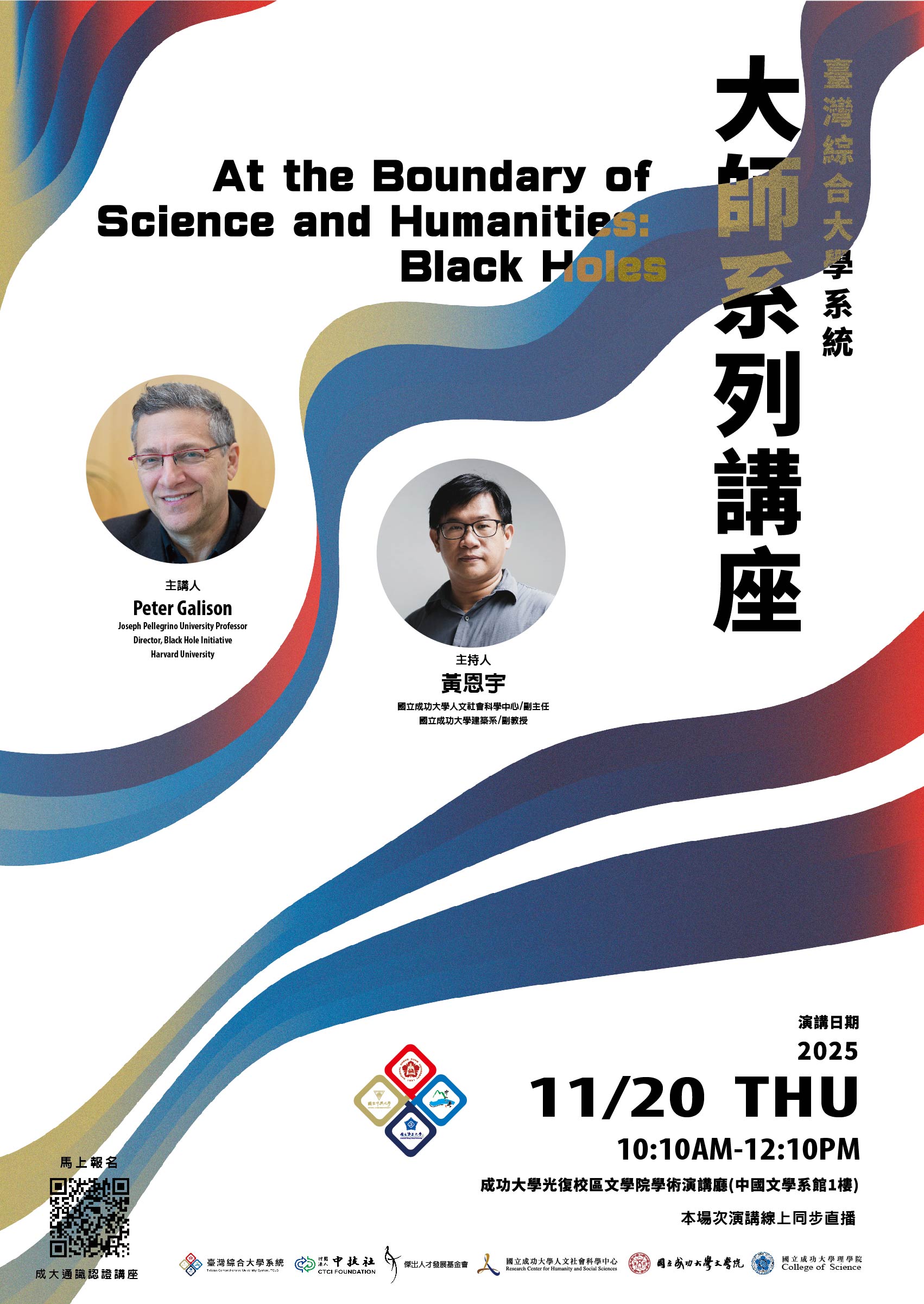
Title:At the Boundary of Science and Humanities: Black Holes
Speaker:Peter Galison
Joseph Pellegrino University Professor
Director, Black Hole Initiative
Harvard University
Moderator: En-Yu Huang / Associate Professor / Vice Director , CHASS NCKU
Time:2025-11-20(Thu.)10:10-12:10
Location:Academic Lecture Hall @ NCKU KUANG-FU Campus, History & Goals College of Liberal Arts
Language:English
Registration:https://activity.ncku.edu.tw/index.php?c=apply&no=16506
Live-stream link: https://reurl.cc/xKE0Qb
(After clicking the link, select “Join from this browser,” enter your name and email address, and then click “Join meeting.”)
Abstract:
It is too easy—and false—to see the humanities and sciences as opposed. Cutting-edge practices of both need and inform one another. The Black Hole Initiative (BHI) at Harvard has, over the last decade, brought together mathematics, physics, astronomy, history and philosophy, around these massive distortions of space and time. One key project, the Event Horizon Telescope, united radio telescopes across the planet, its first image seen by a billion people. With plans to add ten such instruments, responsible siting is key. One of our history/philosophy/culture groups addresses just this. Success depends on engaging local communities across the Pacific, the Americas, and Africa. Scientific epistemology is another shared concern: What constitutes a robust image of a supermassive black hole? Here too humanities and astrophysics converged around the history and philosophy of scientific objectivity. Another example, film: Might documentaries extend beyond traditional aims of popularizing education; could there be epistemological film—capturing science and technology during their unfolding? How is knowledge secured in an all-too human world? Black holes are objects of equations and code, but they also resonate culturally as symbols of passage from life to death. Such films aim to render science as central to culture, shaped by cognition and affect.